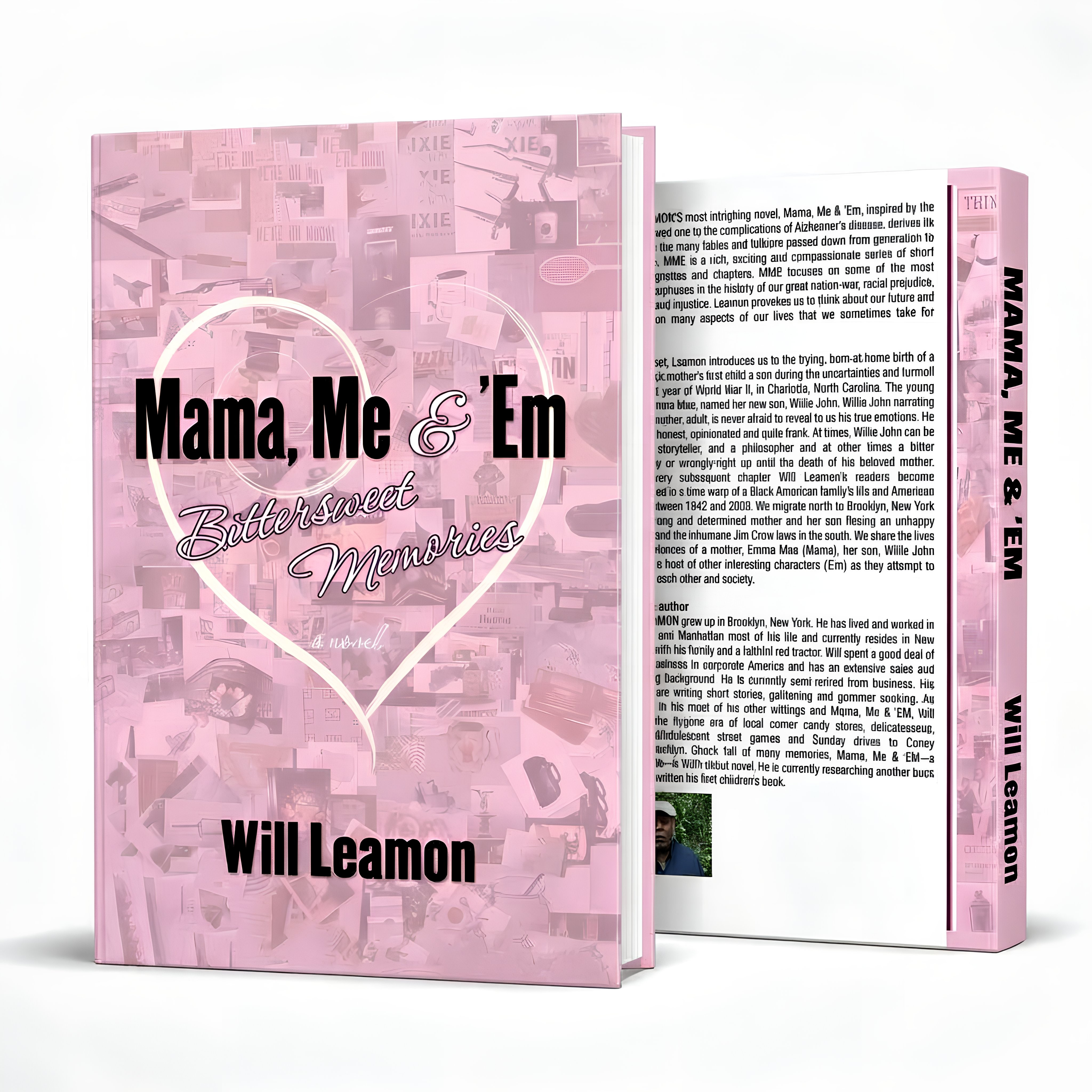
Maternal guidance is often the unseen force that drives us. It has never been clearer than the story of this mother and son.
There is a particular kind of education you cannot get in a classroom. It does not come with a diploma or a grade. It comes at a kitchen table, late at night, over a cup of percolated Maxwell House coffee and a slice of warm pound cake. It comes in the voice of a woman who never finished the sixth grade but could silence a room full of grown men with a single sentence. Willie John’s mother, Emma Mae Holmes, was that kind of teacher. And whether he was ready for the lesson or not, she was always teaching.
Mama, Me and ‘Em is, at its heart, a celebration of the life of a mother of color and all that motherhood demands of a woman the world has already asked too much of. It is also the story of what her son carried because of her, and in spite of her, and sometimes against his own will. Every chapter of this book is shaped by her presence. Even the chapters where she is nowhere in the room.
Her “Isms” and What They Cost Me
Emma Mae had a common sense set of what I always called her “isms.” They were not polished pieces of advice. They were blunt, sometimes startling, always memorable. “A hard head makes a soft ass” was one she deployed often and with surgical precision whenever she felt Willie John was being stubborn or foolish, which, looking back, was more often than he would like to admit. “Remember The Rope” was another. She said it to him when he was still young enough to think that the world might be a fair place. She wanted to make sure Willie John never forgot that it was not. That somewhere above every Black man’s head, there was always some kind of rope waiting, not always the literal one she had described hanging from that railroad trestle back home in South Carolina, but a rope of hatred, of greed, of jealousy, of the particular violence that society reserves for people it has decided do not matter.
She said these things not to frighten him but to arm him. That was the distinction I spent years learning to make. Her directness could feel like a wound in the moment, and only later, usually much later, did it reveal itself to be a kind of armor.
She and Willie John’s uncles, her brothers, the men who went off to a segregated Army to fight a war for a country that made them use separate water fountains, did their best to guide him throughout his life. What Willie John knows about survival, about holding your head up, about looking people in the eye whether they are Black or White, he learned from watching that generation navigate a world that was actively trying to diminish them. They wore their dignity like a second skin. I tried to do the same.
What She Carried, and What She Gave
Her times of happiness, sadness, miscarriages, and disappointments caused anyone to pause and reflect many times over, as Willie John tried to cope with his own situations and the problems the world threw in his path, both as a young man and as an adult man.
He struggled to survive divorce. He wrestled with racism in places he had not expected to find it, in cities he thought would be different, in rooms he had earned the right to be in. Relationships that promised something and then quietly withdrew. Marriages that broke. And then Vietnam, which took some of the closest friends he had in the world, young men who had laughed at the same things he laughed at, who had sat beside him and whose absence left a silence that never fully filled in.
Through all of it, Ma was there. Not always with the right words. Not always with any words. But there, which is its own kind of language. Watching her manage her own losses, watching her absorb blows that would have leveled most people and then get up the next morning and make breakfast, taught me something about endurance that no amount of reading could have replicated.
What she gave Willie John was not a comfortable life. She gave him something harder and more durable than that. She gave him the tools to keep going when comfort was not available. And she gave him, in her roundabout, sometimes maddening way, the deep desire to understand everything around him. To ask why. To not simply accept the surface of things. That is why he became a writer. That is why this book exists.
The Bond Made of Love and Steel
Together, they traveled through life purposefully wearing their philosophies, their fears, and their hard-won common sense heavily upon their backs. They did not always agree. They did not always understand each other. There were long silences between them, and there were arguments that left marks. But beneath all of it was a bond that neither of them had the language for, the kind that does not require explanation and does not survive without cost.
The final chapter of her life was the hardest to write and the hardest to live. Alzheimer’s disease is a long, trying, emotionally devastating way to lose someone. You lose them in pieces, slowly, before they are gone. You watch the sharpness that defined them go soft at the edges. The woman who had never forgotten a single one of her “isms,” who had recited them to Willie John with such precision and conviction, began to lose the words. And then, eventually, she lost more than the words.
Writing through that period of her life, and through my own grief inside it, was the most difficult thing I have ever done at a desk. But it was also the most necessary. Because that ending is part of her story too. It does not cancel out the strength that came before it. It is simply the final thing she endured, and she endured it with the same quiet stubbornness that had defined everything else.
“Mama, Me and ‘Em is not a simple tribute. It is a reckoning. With one woman’s life, with one son’s debt to that life, and with the American story that held them both, beautiful and brutal and enduringly true.”
If you have ever had a mother whose influence you are still sorting through, this book is for you. If you have ever tried to understand someone you loved deeply and never quite succeeded, this book is for you. And if you have ever watched someone you thought was indestructible become fragile, and had to keep loving them through it, this book especially is for you.
3 Comments
Angela Brooks
May 27, 2026This touched me deeply. The way you described your mother’s strength, especially through hardship and loss, felt incredibly real and personal. “Remember The Rope” stayed with me long after I finished reading.
Will Leamon Author
May 27, 2026Thank you, Angela. Those words shaped the way Willie John saw the world. Writing this chapter brought back many difficult but meaningful memories.
Daniel Thompson
May 28, 2026The section about Alzheimer’s was heartbreaking and beautifully written. Watching someone strong slowly fade away is one of the hardest experiences in life, and you captured that pain with honesty and grace.
Rachel Mitchell
May 29, 2026What I loved most was how authentic everything felt. This wasn’t just a tribute to a mother, it felt like a reflection on survival, identity, and generational strength. Truly powerful writing.
Leave a Comment